
Clad as a First-Class Gradient Engine in LibTorch: GSoC 2026 Final Report


At the beginning of GSoC, I wanted to make Clad-generated derivatives usable inside a LibTorch C++ training loop. LibTorch already provides Tensor storage, optimized kernels, and an autograd engine. Clad can generate derivative code while compiling C++. My project explored how these two systems could work together for a supported subset of Tensor operations.
The result includes a Tensor derivative backend, a compiler frontend that
connects generated pullbacks to torch::autograd::Function, and an MNIST
training example with correctness tests and reproducible benchmarks. Several
compiler improvements developed along the way have been merged into Clad;
others remain under review.
Performance became a substantial part of the work. In our CPU MNIST experiment, the optimized direct Clad path reduced measured training time by 15.4% relative to native LibTorch autograd, but still used 26.0% more peak Tensor storage. Investigating that remaining gap led to a useful finding: some generated Tensor handles kept storage alive after its last use. A manual early-release experiment brought the peak close to the native reference.
This report follows the implementation and the experiments behind those results. It continues my initial project introduction.
Making Tensor derivatives work
The first challenge was representing derivatives of Tensor values correctly.
In reverse-mode AD, an adjoint accumulates contributions to a value’s
derivative. A scalar adjoint can start at 0. A Tensor adjoint also needs the
right shape, dtype, and device, with storage independent of the original value.
Copying a Tensor copies its handle and shares the underlying storage. Clearing that copy can therefore overwrite the original data. Default construction has a different problem: it creates an undefined Tensor, without the runtime shape needed by a pullback that writes into it.
I introduced clad::zero_like to express construction of a zero adjoint from an
existing value. For a defined floating-point CPU Tensor, the essential rule is:
namespace clad {
at::Tensor zero_like(const at::Tensor& value) {
  at::NoGradGuard guard;
  return at::zeros_like(value);
}
}
This also separates construction from zero_init, which resets an existing
adjoint. Subsequent changes let Clad reuse the type-level rule when constructing
default reverse-forward results and centralize its use in adjoint generation.
An ordinary function returning a Tensor by value no longer needs its own
reverse_forw helper just to repeat the same initialization rule. Explicit
helpers still serve cases involving aliasing or additional saved state.
The operator derivatives are a separate layer. I implemented custom pullbacks for the supported Tensor operations, including arithmetic, reductions, ReLU, matrix multiplication, and views. Clad composes these rules into the derivative of the user’s C++ function. LibTorch executes the underlying kernels; Clad does not need to differentiate their implementations.
Broadcasting and strided views made this more than a collection of scalar formulas. For example, a broadcast bias receives the sum of contributions over the expanded dimensions. Tensor copies and moves also require care because shared primal storage does not imply that independent local adjoints should share storage. Tests cover these cases alongside the simpler contiguous path.
Separating entry discovery from derivative planning
Clad traditionally discovers differentiation requests through calls such as
clad::gradient. The Torch integration needs to request a derivative from a
different entry point, while retaining Clad’s dependency planning and analyses.
I separated ordinary Clad invocation discovery into CladInvocationVisitor.
The Torch frontend has its own visitor, and both describe the required work
with a DiffRequest. A shared DiffScheduler::PlanRoot submits those requests
to the planner. The scheduler checks the invocation’s #pragma clad interval
and queues roots discovered while another request is being planned.
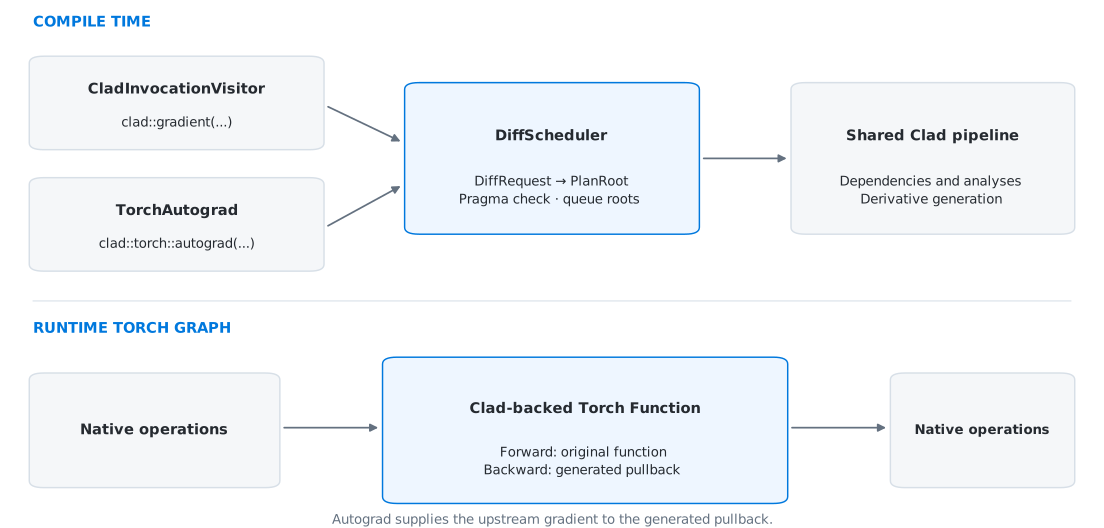
This keeps frontend-specific recognition separate from derivative generation. Adding a Torch entry point does not require a second AD engine, and ordinary Clad calls continue through the same planning infrastructure. The refactor is tracked in PR #2376.
Connecting a pullback to Torch autograd
For a supported function, the explicit entry point looks like this:
using Tensor = at::Tensor;

Tensor block(const Tensor& x, const Tensor& weight) {
  return (x * weight).relu();
}

// x and weight are CPU floating-point Tensors requiring gradients.
auto y = clad::torch::autograd(block, "x,weight", x, weight);
y.sum().backward();
The frontend identifies block, requests a pullback, and replaces the entry
call with an adapter based on torch::autograd::Function. Conceptually, the
replacement is:
using Node = clad::torch::detail::AutogradFunction<block, block_pullback>;
auto y = Node::apply(x, weight);
The adapter’s forward method runs the original function and saves its inputs.
During backward, Torch supplies the output’s upstream gradient, and the adapter
passes it to the generated pullback. The returned input gradients then continue
through the surrounding Torch graph. A CLAD_TORCH_AUTOGRAD annotation also
allows supported direct calls to request this integration.
A pullback is the appropriate interface here because its output seed can be arbitrary. A scalar-loss gradient entry normally starts the reverse pass with a seed of one; a function embedded in a larger computation must receive the contribution from that computation instead. PyTorch’s C++ autograd interface provides this forward/backward boundary.
The prototype targets first-order derivatives of supported CPU Tensor functions. Torch still manages the surrounding graph. Within a Clad-backed region, the generated pullback supplies the backward program. Separate integration tests check this boundary, including composition with native autograd and upstream gradients that are not simply one.
Validating a complete training workload
I used MNIST to move beyond individual operator tests. The model has a 784-to-64 hidden layer with ReLU and a 64-to-10 output layer. Its loss is the sum of squared differences from one-hot targets, divided by twice the batch size. Training uses mini-batch SGD with batch size 128 and learning rate 0.05.
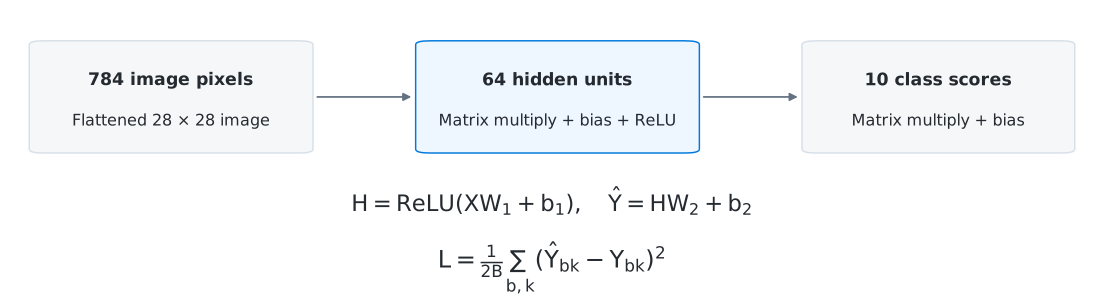
LibTorch loads the data and executes Tensor kernels. Clad generates the loss derivative for both weight matrices and both biases. Gradient checks compare against native autograd and central finite differences, including strided weights. The training runs use all 60,000 training images and 10,000 test images for ten epochs.
For the detailed optimization experiments below, I call clad::gradient
directly under NoGradGuard. This measures the generated training path without
the Torch Function adapter. The native reference uses the same training loop,
initialization, batches, and SGD updates with LibTorch autograd. Keeping these
paths separate makes the benchmark’s scope explicit.
All stages in the experiment reached 93.9% test accuracy, and their final parameters had a maximum absolute difference of zero from the native reference in this run. Correctness checks also run independently of full training, so a similar accuracy alone is not our test of the derivatives.
Removing work from the generated backward pass
Before the staged experiment, I put the model’s forward operations directly inside the differentiated loss. With a separate prediction helper, an ordinary generated pullback can recompute the helper’s intermediates because its interface does not receive those values from the earlier forward call. Keeping the operations in the root function lets its reverse sweep reuse local values. This is already part of S0, the baseline below.
S0 also uses native ReLU backward kernels and ordinary zero_like semantics.
The Tensor backend had earlier explored representing zero with an undefined
Tensor. The final backend constructs real zero adjoints, so custom pullbacks
can work with them normally; the later optimizations focus on avoiding work
and reusing storage where the operation permits it.
S1 omits gradients for fixed data
The loss requests gradients for the model parameters, but the original full
matrix pullback also computes an image gradient. For Y = XW and upstream
gradient G, the weight contribution is XᵀG, while the image contribution is
GWᵀ. This training loop needs the former. The latter costs another matrix
product and a 128-by-784 buffer.
Selecting gradient outputs alone is not generally permission to omit every
other adjoint. An unselected parameter can be overwritten with an active value
and become an intermediate in the derivative. I added the explicit option
assume_unselected_inactive for callers who can promise that unselected root
inputs, including their reachable storage, remain inactive. The fixed images
and targets in this workload satisfy that promise.
I also added clad::no_adjoint, an empty type that preserves an omitted
gradient’s position in a pullback signature. A small scalar example is:
// product(data, weight) = data * weight
namespace clad::custom_derivatives {
void product_pullback(double data, double /*weight*/, double seed,
                      clad::no_adjoint, double* d_weight) {
  *d_weight += data * seed;
}
}
Clad can select this overload when only the weight contribution is needed. The same approach applies to the Tensor matrix pullback. Selection happens while compiling. Generated pullbacks also retain omitted positions with the marker, distinguishing output subsets whose remaining pointer types would otherwise be identical. Existing full custom pullbacks remain usable through a fallback with real output storage.
Varied Analysis, enabled by enable_va, is already present in S0. It tracks
which values depend on selected inputs, but a full handwritten custom pullback
still contains its own computations. The partial overload gives Clad an
implementation that actually omits the unwanted output work.
S2 and S3 reduce allocation and copying
In S2, matrix pullbacks accumulate directly into existing gradient storage with
addmm_, where dtype and aliasing conditions permit. This avoids materializing
a separate matrix product and then adding it to the destination.
S3 groups further buffer improvements: elementwise accumulating kernels, copy-adjoint propagation without a redundant temporary, and reuse of a ReLU seed when ownership permits. Ownership matters because moving a Tensor handle does not remove other aliases. Borrowed or shared storage must remain protected.
S4 removes an unused default adjoint
Inspection of the generated code revealed another allocation source. While
processing a temporary member-call receiver, the outer visitor could already
provide its adjoint. Visiting the inner call could nevertheless create a
second default adjoint through zero_like. The outer visitor then replaced
that returned adjoint reference, leaving the extra initialization unused.
I fixed this specific case in PR #2496. The MNIST derivative loses three allocations per batch. This is compiler-side work elimination: the extra Tensor never needs to be constructed.
Measuring the changes
The experiment uses Clang 21.1.3 with -O3, LibTorch 2.11 CPU, FP32, and one
thread pinned to CPU 0. Each case has six timing runs in rotated order. Timing
includes batch copies, forward, backward, and SGD, and excludes data loading,
shuffle preparation, evaluation, and serialization. The reported ten-epoch
time is the sum of the per-epoch medians across those runs.
Memory instrumentation runs separately. It counts newly allocated CPU Tensor storage during training, excluding pre-existing datasets and model storage, allocator reservations, and C++ graph metadata. Allocation volume measures all bytes allocated during an epoch; peak live storage measures how many of those bytes coexist.
| Case | Training time (s) | Allocated per epoch (MiB) | Peak live storage (KiB) | Allocations per batch |
|---|---|---|---|---|
| S0 baseline | 2.065 | 776.3 | 1420.8 | 35 |
| S1 partial pullbacks | 1.373 | 412.9 | 827.8 | 29 |
| S2 direct matrix accumulation | 1.369 | 398.2 | 827.8 | 28 |
| S3 buffer improvements | 1.363 | 395.9 | 827.8 | 27 |
| S4 unused-adjoint fix | 1.357 | 379.0 | 790.8 | 24 |
| Native LibTorch autograd | 1.603 | 359.8 | 627.8 | 27 |
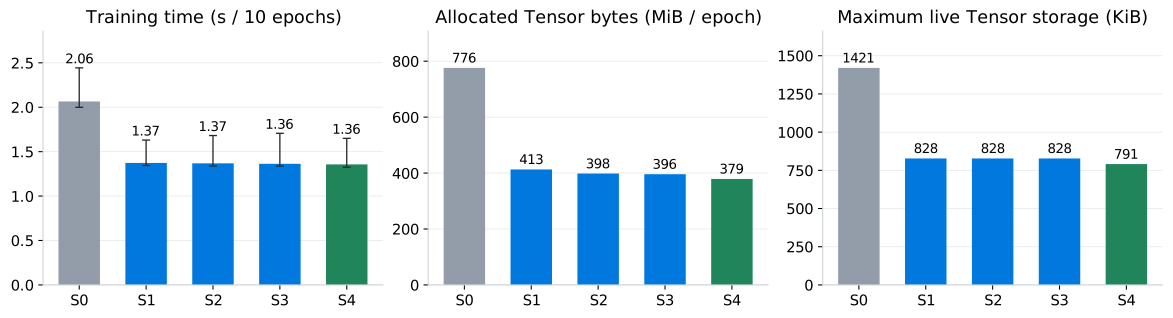
The time error bars show the minimum and maximum total training times across the six runs. The largest improvement is S0 to S1: training time falls by 33.5%, and peak storage by 41.7%. Later stages mainly reduce allocations.
The raw timing and allocation measurements, ablation summary, and memory lifetime summary are available alongside this report.
Understanding the remaining memory gap
A Tensor’s last numerical use does not necessarily end its lifetime. A local handle can keep storage alive until the function returns, and another handle can retain an alias even after the first is moved. Generated code contained patterns like this:
Tensor saved_adjoint = clad::zero_like(hidden);
Tensor d_hidden = saved_adjoint;  // Another handle to the same storage.
// ... backward computations use d_hidden ...
Even when the backward computation finishes using d_hidden, the redundant
saved_adjoint handle can retain that storage. Forward intermediates also
remain live beyond their last backward use. This explains why eliminating
allocations alone does not necessarily bring the peak down to native autograd.
To test the cause, I edited a copy of the generated derivative and inserted
Tensor::reset() after the last use of each local handle. The experiment kept
the derivative formulas and real zero_like initialization. Releasing a
redundant gradient alias also made a ReLU seed uniquely owned, enabling an
existing kernel to reuse it.
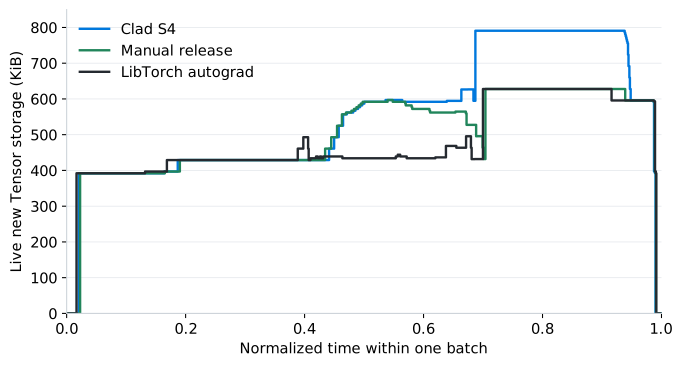
The peak fell from 809,772 bytes to 642,856 bytes, a 20.6% reduction. Native autograd used 642,864 bytes, just eight bytes more. Final parameters still matched, accuracy remained 93.9%, and newly tracked storage returned to zero at every batch end.
Contributions to Clad
The integration exposed issues that also matter to other C++ types and frontends. The following groups summarize the related compiler contributions. Statuses are recorded as of November 5, 2026.
| Contribution | Pull requests | Status |
|---|---|---|
| Construct zero adjoints from values and reuse the rule across generation paths | #1932, #2068, #2336, #2353 | Merged |
| Correct derivative lookup, temporary cloning, return handling, default initializers, and member calls | #1832, #1926, #2066, #2067, #2165, #2168 | Merged |
| Respect closed pragma intervals | #2175 | Merged |
| Separate entry discovery from shared request planning | #2376 | Open |
| Support partial pullbacks and the inactive-input assumption | #2495 | Open |
| Avoid unused default adjoints for temporary receivers | #2496 | Open |
The LibTorch backend, adapter, tests, and benchmarks are developed in the project fork. They build on these compiler changes. I plan to submit the integration upstream once the supporting mechanisms have been merged.
Next steps
Two compiler improvements follow directly from the experiments. First,
generated pullbacks should be able to reuse the values produced by a separate
forward helper. Clad already provides pullback_state for a custom
reverse_forw/pullback pair to exchange per-call state. The next step is to
automate the selection and transport of saved values for generated functions.
Second, generated code should release Tensor storage once no later operation needs it. The manual experiment gives a concrete target, but general support must account for control flow, aliases, escaped references, and the type’s release semantics. These two directions address complementary costs: recomputation across function boundaries and excessive lifetimes within a generated function.
I would like to thank my mentors Aaron Jomy, David Lange, and Vassil Vassilev. Their feedback helped turn problems encountered in one Tensor backend into improvements that other Clad users can build on.